
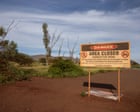
A group of Indigenous Australians whose traditional lands have been contaminated for decades by asbestos waste have launched a $1.5bn legal claim against an Australian state government.
The Banjima people are traditional owners of land in Western Australia’s Pilbara region, including Wittenoom, the site of one of Australia’s worst industrial disasters.
More than 3m tonnes of toxic waste at Wittenoom, dumped by blue asbestos mines that operated from 1943 to 1966, have remained on the land for decades. It has been described as “the largest contaminated site in the southern hemisphere”.
The Banjima Native Title Aboriginal Corporation (BNTAC) initiated legal proceedings on Tuesday against the state of Western Australia, seeking removal of the waste, remediation of polluted waterways, and compensation for harm caused.
Blue asbestos is considered the most hazardous form of asbestos and was identified decades ago as causing the cancer mesothelioma. Its fibres do not break down over time in the environment.
In a statement of claim filed in the federal court, BNTAC’s lawyers argue that the asbestos contamination has prevented Banjima people from being able to exercise their native title rights.
Johnnell Parker, a Banjima traditional owner and deputy chair of BNTAC, said: “They’ve disconnected us from that place of Country that we can’t visit anymore.”
There was “not one family” who lived in the now-shuttered town of Wittenoom unaffected by mesothelioma, Parker added. “I’ve lost loved ones to this disease through no fault of their own.”
“I’ve had uncles and aunties that grew up there that played in the [asbestos] tailings when they were kids,” Parker said. “They live with this fear now of getting mesothelioma.”
“That has been generations in the making,” she said. “We’re in a perfect position now to ask the question of the government. What are you going to do? Out of sight, out of mind is not good enough.”
A 2016 study found that Indigenous Western Australians have the highest mortality rate from mesothelioma in the world, with the majority of cases linked to asbestos mining and contamination at Wittenoom.
BNTAC is seeking court orders to require the WA government to seal three abandoned blue asbestos mines, clear three tailings dumps, and to remove asbestos from the now-closed Wittenoom racecourse and Wittenoom Gorge airport.
Its statement of claim argues that WA “has taken no steps, and has decided to take no steps, to remove, contain or otherwise remediate” blue asbestos in Wittenoom.
As early as 1994, a government committee recommended that the state “accept responsibility to remove and/or stabilise asbestos tailings in both the town and mine site”.
BNTAC is being represented in the federal court by Peter Gordon, a senior parter at Gordon Legal and a renowned litigator who last year secured the largest class action settlement in Australian history.
Gordon won the first asbestos compensation case regarding the Wittenoom mines in 1988, representing mine worker and mesothelioma victim Klaus Rabenalt.
“I still have vivid memories of landing on the Wittenoom airfield in 1987 and getting out and stepping onto blue asbestos fibre, which had been laid there as part of the tailings,” Gordon said. “It’s still there – it’s never been cleaned up.”
Though the state government passed legislation in 2022 to close the township of Wittenoom, “they didn’t remove a single shovel load of blue asbestos waste”, Gordon said.
Gordon said preliminary engineering advice estimated a cost of $1.5bn to remove the three tailing dumps. “All of these problems are manageable, they’re just expensive,” he said. “That expense, we say, needs to be measured against the fact that … the [WA] government has reaped royalties of $70bn just from the proceeds of mining in that area [since 2016].
“The assault and the degradation here is cultural, it’s health and safety, and it’s environmental.”
Before launching legal proceedings, BNTAC met with the WA government last September to discuss remediation of the asbestos waste.
The WA premier, Roger Cook, on Wednesday said he “wasn’t surprised” by the legal action. “I’ve been speaking with the Banjima and their legal representatives about what they want to see, which is justice that they regard in relation to the impact of the asbestos mine at Wittenoom,” he said.
“I would prefer a negotiated outcome, but I absolutely and fundamentally respect their right to seek justice for what they believe are health impacts in relation to their population, but also the damage that’s been done to their country.
“I think we’re all struck by the fact that Wittenoom is a very dreadful part of our history, and whatever role we can play to fix that, we’ll obviously be very happy to do so.”
Two of the mines were run by Australian Blue Asbestos, a company founded by Lang Hancock, a mining magnate and the father of Australia’s wealthiest woman.
The court case has been listed for a case management hearing on 9 April in Perth.