
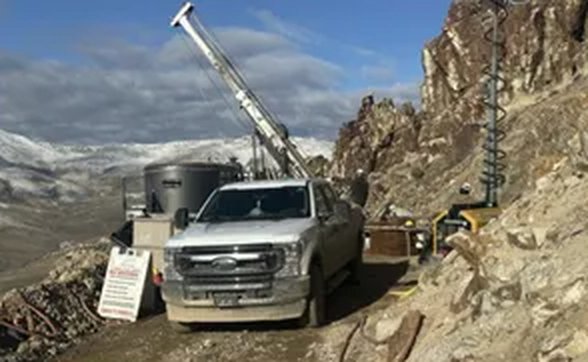
Giant Mining Corp. (CSE: BFG; OTC:BFGFF; FWB:YW5) has announced plans for a multiphase drill and exploration program at its 9,684-acre Majuba Hill copper-silver-gold project in Pershing County, Nevada. The company intends to conduct up to 10,000 feet (3,048 meters) of core drilling, with Phase 1 comprising approximately 5,000 feet (1,524 meters), followed by an additional 5,000 feet in Phase 2. The program will also include underground mapping and sampling, as well as surface sampling to inform future drill targeting.
The initiative will leverage data from over 100 previous drill holes totaling more than 89,000 feet of drilling, as well as surface geological mapping and geochemical sampling. According to the company, recent reviews have identified multiple mineralized breccia bodies, with high-grade intercepts of copper and silver, and intervals of anomalous gold occurring along the margins of hydrothermal-magmatic tourmaline matrix breccia pipes.
“This planned multiphase drill and exploration program represents an important next step in advancing Majuba Hill,” said David Greenway, president and CEO of Giant Mining, in a company news release. He added that the program is aimed at systematically testing copper-silver targets based on geological and historical data.
Drilling will initially target three breccia zones identified through historic and recent drilling, 3-D modeling, and surface geochemistry. The zones, named Southern, Ball Park, and Northern, are located along the intersection of northwest and northeast structural corridors. The company stated that drill fences in the Southern zone will test for extensions of high-grade intercepts previously reported in drill holes MHB-30 and MHB-32.
Hole MHB-30 returned 243.8 meters (800 feet) of 0.43% Cu and 24.6 g/t Ag, including a 22.6-meter interval of 2.72% Cu and 30.73 g/t Ag. Hole MHB-32 intersected 271.1 meters (889.5 feet) of 0.16% Cu and 9.24 g/t Ag, with a significant 115.7-meter interval grading 0.33% Cu and 16.97 g/t Ag, and several included zones of higher copper and silver values.
According to the company, the breccia zones exhibit several key features, including high-grade shingle clast breccias adjacent to sharp breccia contacts, multi-element mineralization, and a downward flaring geometry. Drill fences are also planned for the Ball Park and Northern breccia zones, with the latter intended to test outcropping breccia and geochemical anomalies. Historic drill hole MF-02 in the Ball Park zone intersected 36.6 meters (120 feet) grading 0.51% Cu and 21.7 g/t Ag.
Gold, Silver, and Copper Sector Commentary Reflects Volatility and Structural Support
In a January 30 article, Frik Els reported that copper pulled back from all-time highs reached earlier in the week, with March copper futures declining as much as 9.5% before settling at $5.92 per pound, down 4.5% on the day. Despite the dip, the article noted that copper “remains in positive territory for the year with gains of just over 4% year to date.” The pullback was attributed to profit-taking triggered by the nomination of a new U.S. Federal Reserve chair.
On February 1, Chen Lin described the sharp drop in silver prices as “a devastating drop” tied to strategic short positioning after the Asian markets had closed and during futures settlement. He noted that silver settled at $78.29 and stated that “silver producers are still relatively cheap even [after] a big run-up,” adding that “silver juniors are particularly cheap.” He wrote that price consolidation could provide “a good opportunity.”
The following day, Matthew Piepenburg wrote that silver’s drop was “an entirely engineered flushing of the silver price to save a fatally trapped cabal of bankers.” He pointed to long-term supply pressure, stating, “silver has seen five consecutive years of 200M ounces/year of supply deficits, totaling over 1B ounces.” He concluded that “the world wants physical metals, not paper tricks,” and emphasized that physical demand was continuing.
Also on February 2, Euronews reported that gold had reached a record high of $5,600 per ounce before dropping to $4,770 per ounce. The article described strong global demand, noting that consumers were buying coins, bullion, and exchange-traded products. Despite recent fluctuations, prices were “much higher than a year ago,” and demand was described as a reaction to geopolitical tensions and uncertainty around U.S. monetary policy.
Drill Program Targets Breccia Zones and Historic Intercepts
The multiphase drill program planned by Giant Mining in 2026 will focus on breccia margins within the Southern, Ball Park, and Northern breccia zones. Phase 1 drilling will consist of six to eight core holes totaling up to 5,000 feet, designed to intersect both sides of tourmaline breccia pipes and follow up on high-grade intercepts from previous drilling campaigns.
Two drill fences are planned for the Southern breccia zone. These fences are designed to test the continuation of mineralization encountered in MHB-30 and MHB-32 and extend it toward the peak of Majuba Mountain. According to the company, underground mapping and sampling are currently underway to identify the breccia margins in this area.
One drill fence will be positioned in the Ball Park breccia zone. The company reports that surface mapping and soil geochemistry suggest the conical hill in this area could represent the upper portion of a breccia pipe. Historic hole MF-02 intersected 36.6 meters at 0.51% Cu and 21.7 g/t Ag, while adjacent core hole MM-17 cut 28.65 meters of tourmaline breccia.
A third drill fence will test the Northern breccia zone with stepout holes aimed at outcropping breccia and geochemical anomalies in copper, molybdenum, and silver.
Additional geological work is also planned. Mapping and sampling are in progress for the Ball Park and Northern zones, and further surface sampling and reconnaissance geologic mapping are expected at the DeSoto, Copper-Gold, and Section 4 targets. These follow-ups stem from property-wide soil geochemistry and geophysical work, which the company says could justify inclusion in Phase 2 drilling.
The breccia pipes at Majuba Hill are interpreted to have formed from the explosive release of gas-rich fluids from cooling magma, cementing rock fragments with a matrix of quartz, tourmaline, sulphides, and oxidized sulfides. According to the company, Giant has compiled a comprehensive exploration database that includes 3-D geology and mineralization models, and it is using this database to guide its targeting efforts.
Ownership and Share Structure1
Roughly 15.1% of Giant Mining’s shares are held by insiders, while the rest are owned by retail investors.
The company’s market capitalization is approximately CA$21.82 million.
Giant has 94.85 million shares outstanding and a 52-week range of US$0.0880 and US$0.3640.
| Want to be the first to know about interesting Gold and Silver investment ideas? Sign up to receive the FREE Streetwise Reports’ newsletter. | Subscribe |
The information listed above was updated on the date this article was published and was compiled from information from the company and various other data providers.